Screw Jack Series Selection for Stage Lifting and Rigging Systems
For stage lifting and rigging, the right screw jack series is decided by four project numbers: the load carried at each lifting point, the travel speed the cue requires, whether the load must hold position when power is removed, and the stroke the scenery or truss has to travel. JINYU builds three series that map onto those numbers. The SWL series covers the heaviest single-point loads at the slowest travel speeds — 2.5–120 t at 0.1–0.6 m/min. The JWM series spans the widest load band, 1–1000 kN at 0.2–1.8 m/min, with gear ratios up to 32:1 for controlled positioning. The JWB series is the high-speed option for dynamic lifts, 5–500 kN at 0.5–5 m/min. All three are worm gear screw jacks, and all three are used in multi-point lifting systems where several units must move as one.
This guide is written for stage equipment designers, rigging engineers and technical buyers who have to justify a series decision on load, speed, holding behaviour, stroke, environment and documentation — not on catalogue appearance.
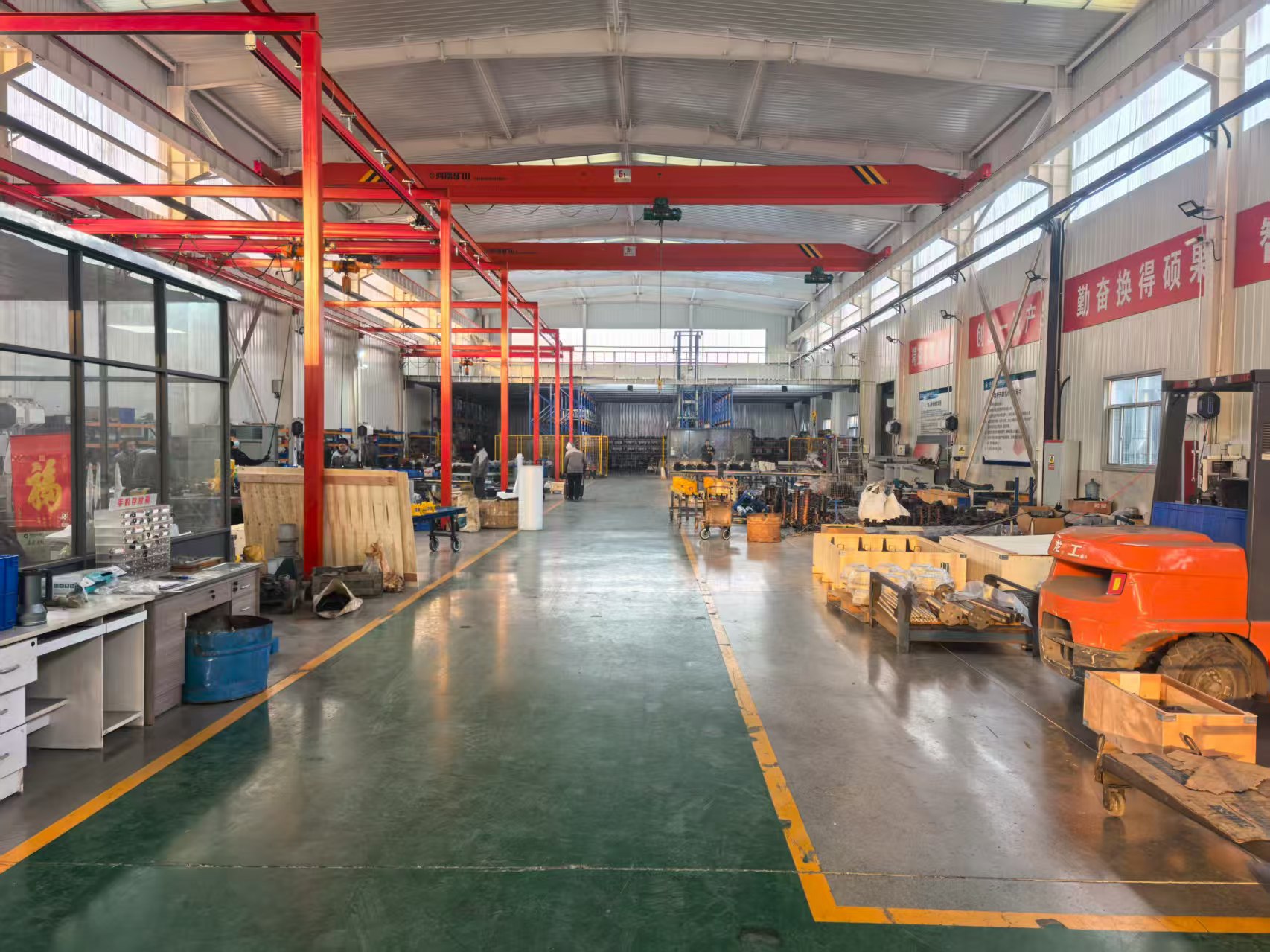
Problem Definition: What Stage Lifting Actually Asks of a Screw Jack
A stage lift is not a single component problem. The screw jack is one element in a system made of motor, coupling, gearbox, shafting, controller and structure, and the failure modes that concern rigging engineers sit at the system level, not the unit level.
The recurring requirements in stage and rigging work are consistent across projects:
- Holding without power. Scenery battens, acoustic shells, trusses and platform sections must stay where they are put, including during a power interruption or an emergency stop.
- Slow, repeatable positioning. Lighting rigs and focus positions change by millimetres, and the position has to repeat cue after cue.
- Speed for scene changes. Dynamic lifts and shifting platforms need travel fast enough to fit inside a changeover window.
- Multi-point synchronisation. A platform lifted by four, six or more units will rack or jam if the units do not travel together.
- Low maintenance in a busy venue. Service access is typically restricted to dark hours and load-out days.
- Environment. Dust, humidity, outdoor weather and wash-down duty all change the required ingress protection and material choice.
The practical consequence is that a single rated capacity figure is not enough information to select a series. Two projects with the same 30 kN load per point can require completely different units if one needs 2.5 m/min and the other needs holding position with the motor de-energised.
Industry Background: Why the Worm Gear Screw Jack Is the Default Stage Mechanism
The screw jack segment is a large and still growing part of the linear motion industry. The global screw jacks market was estimated at USD 14.26 billion in 2024 and is projected to reach USD 26.82 billion by 2035, a CAGR of 5.91% (Market Research Future). Within that segment, worm gear screw jacks held the largest share at 38.5% in 2025, a position attributed to their self-locking behaviour and heavy-load capacity (Dataintelo / Persistence Market Research). Regionally, Asia-Pacific accounted for a 42.3% revenue share of the linear motion market in 2025, supported by manufacturing growth in China and India (Grand View Research).
Other established suppliers active in this space include Power Jacks Limited, Joyce Dayton Corp, ZIMM Group and Thomson Industries, alongside regional manufacturers such as JINYU.
The mechanism that matters for stage safety
In a worm gear screw jack, a worm gear reduction stage drives a lifting screw. The two lifting screw types behave very differently:
- Trapezoidal screw (used in the SWL and JWM series). The screw and nut slide against each other. Sliding friction combined with the worm gear geometry produces self-locking behaviour, so the load can be held in position without a brake. This is the mechanism that underpins the self-locking screw jack concept used in scenery, rigging and platform holding duty.
- Ball screw (used in the JWB series). Rolling balls replace sliding contact, which raises efficiency and allows much higher travel speeds. Because rolling contact removes the sliding friction that produces self-locking, a ball screw jack should not be assumed to hold a load by itself; holding must be provided by the drive and brake system, and the unit should be specified with that requirement stated openly.
Selection rule: if the specification says “the load must remain in position with the motor off”, the trapezoidal, self-locking series (SWL and JWM) is the natural starting point. If the specification is driven by cycle speed, the JWB ball screw series is the starting point, and the holding function is designed into the drive.
Detailed Solution: The Three JINYU Series and Where Each One Fits
SHANDONG JINYU MACHINERY CO., LTD (brand: JINYU) is a manufacturer of screw jacks, worm gear reducers and servo electric cylinders, founded in 1984 and based in Dezhou City, Shandong Province, China. The three series below share the same base architecture and materials, and differ in screw type, load band, speed band, stroke and protection class. All three series use a screw of 40Cr or 45# steel, an HT200 cast iron housing, a bronze nut (CuSn6Zn6Pb3), gears of 40Cr or 42CrMo, and a 45# carbon steel shaft.
SWL Series — heavy scenery, slow travel, self-locking hold
The SWL series is a self-locking, trapezoidal screw jack available in manual and electric versions. It carries 2.5–120 t per unit, travels at 0.1–0.6 m/min, and offers the longest stroke of the three series at 100–2000 mm. Gear ratios are 6:1, 8:1, 10:1, 24:1 and 32:1. Operating temperature is −20 °C to 80 °C with IP54–IP55 protection. Its listed application industries include stage equipment, lifting platforms, metallurgy, water conservancy, construction and grain and oil processing.
On stage, the SWL profile fits heavy scenic units, acoustic shells, roof and truss lifting assemblies, and any position where the load is high and the demanded speed is low. The 2000 mm maximum stroke is the practical advantage when tall scenery has to travel a long distance rather than move quickly.
JWM Series — the widest load band with slow, controlled positioning
The JWM series is a trapezoidal, low-speed screw jack with a load band of 1–1000 kN — the widest of the three — and a travel speed of 0.2–1.8 m/min. Stroke range is 100–1500 mm and gear ratios are 5:1, 6:1, 8:1, 10:1, 20:1, 24:1 and 32:1. Its operating temperature reaches 100 °C, and protection is rated IP55–IP65, the highest of the three series. Listed application industries include precision machinery, automation lines, medical equipment, packaging machinery, tooling fixtures, plastic machinery and printing machinery.
For stage work, the combination of a wide load band, a 32:1 ratio option and IP65 protection makes the JWM the series to examine when lighting rigs, trusses and platform sections need slow, accurate, repeatable positioning, when the load per point varies across the project, or when the venue is dusty, humid or partially outdoor.
JWB Series — ball screw speed for dynamic stage lifts
The JWB series is a ball screw, high-speed screw jack. It carries 5–500 kN at 0.5–5 m/min — the fastest travel of the three series — with a stroke range of 100–1500 mm and gear ratios of 5:1, 6:1, 8:1 and 10:1. Temperature range is −20 °C to 80 °C with IP55–IP65 protection. Listed application industries include high-speed automation production lines, robotic equipment, precision lifting platforms, logistics conveying, aerospace auxiliary equipment and CNC machine tools.
The JWB is the series for dynamic stage lifts: fast scene changes, moving platform sections, wagon and revolve drives, and touring set elements where a changeover window is short. Because it uses a ball screw, holding behaviour must be confirmed with the drive supplier as part of the design, not assumed from the unit alone.
Step-by-Step Breakdown: Selecting a Series for a Stage or Rigging Project
- Establish the load at each lifting point, not the total load. Divide the total lifted mass by the number of units, then account for uneven load distribution and acceleration effects. The result has to sit inside the series band: 2.5–120 t for SWL, 1–1000 kN for JWM, 5–500 kN for JWB. A point load that lands in the upper part of a band is usually better served by a larger frame size than by a higher gear ratio.
- Turn the cue time into a required speed. Divide the travel distance by the time available for the move. If the answer falls below 0.6 m/min, SWL or JWM can satisfy it. Between 0.5 and 1.8 m/min, the JWM band applies. Above 1.8 m/min, only the JWB band reaches the requirement.
- State the holding requirement explicitly. If scenery must remain suspended or a platform must stay level with the motor de-energised, the trapezoidal self-locking series (SWL, JWM) matches that requirement directly. If the project calls for high cycle speed with a ball screw, specify the brake and holding function as part of the drive package.
- Check stroke against available space. SWL supports up to 2000 mm of stroke; JWM and JWB support up to 1500 mm. Stroke, retracted length and mounting geometry must be checked together against the grid height and the structure below stage.
- Match the environment. For clean indoor venues, IP54–IP55 units are adequate. For dusty, humid or wash-down areas, the JWM or JWB IP55–IP65 range is the more suitable starting point, and where corrosion resistance is the governing requirement, a stainless steel screw jack configuration is available as a customisation.
- Design the multi-point system as one system. Units lifting a common platform should share the same series, frame size and gear ratio so that travel per motor revolution is identical. Right-angle layouts are handled with bevel gear screw jack configurations, and vertical stability with keyed screw jack arrangements where the screw must resist rotation or side load. Ratio selection (for example 32:1 versus 10:1) then becomes a tuning tool for matching the units to the available motor speed.
- Validate before committing the full order. JINYU produces screw jacks on an ODM basis with customised size, load, stroke, gear ratio, voltage, logo and material, at a minimum order quantity of 1 unit and a monthly capacity of 10,000 units. Every unit is 100% tested before shipment, and typical lead time is 30–45 days.
Use Cases: Matching Series to the Stage Function
| Stage or rigging function | Governing requirement | Series to examine first |
|---|---|---|
| Heavy scenic batten, acoustic shell, roof or truss lifting | Highest load per point, long stroke, hold with power off | SWL |
| Lighting rig or truss repositioning with fine focus positions | Slow, repeatable positioning over a wide load band; IP protection | JWM |
| Fast scene change, moving platform section, revolve or wagon drive | Travel speed above the slow band; drive-side holding | JWB |
| Synchronised multi-point platform | Identical travel per revolution across all units; minimum service access | JWM or SWL, same frame size and ratio per point |
| Outdoor, humid or wash-down stage area | Corrosion resistance and ingress protection | Stainless steel screw jack configuration within the selected series |
Adjacent industries are moving in the same direction. Stainless steel screw jacks are increasingly used in offshore wind and food processing because of high corrosion-resistance requirements (Thomson Linear / Dataintelo) — the same material logic that applies to outdoor and wet stage environments.
Comparison Table: SWL, JWM and JWB Series for Stage Applications
| Specification | SWL Series | JWM Series | JWB Series |
|---|---|---|---|
| Screw type | Trapezoidal | Trapezoidal | Ball screw |
| Self-locking | Yes (self-locking design) | Trapezoidal, low-speed design | Not assumed — holding via drive/brake |
| Lifting capacity | 2.5–120 t | 1–1000 kN | 5–500 kN |
| Lifting speed | 0.1–0.6 m/min | 0.2–1.8 m/min | 0.5–5 m/min |
| Stroke range | 100–2000 mm | 100–1500 mm | 100–1500 mm |
| Gear ratios | 6:1, 8:1, 10:1, 24:1, 32:1 | 5:1, 6:1, 8:1, 10:1, 20:1, 24:1, 32:1 | 5:1, 6:1, 8:1, 10:1 |
| Temperature range | −20 °C to 80 °C | −20 °C to 100 °C | −20 °C to 80 °C |
| Protection | IP54–IP55 | IP55–IP65 | IP55–IP65 |
| Drive options | Manual or electric | Motorised configurations | Motorised configurations |
| Typical stage role | Heavy scenery and truss lifting | Precision positioning, synchronised platforms | Fast scene changes, dynamic lifts |
Compliance and Documentation to Verify Before Ordering
Stage equipment usually falls under venue safety reviews and, in the EU, under machinery documentation requirements. The relevant checks are certificate scope, certificate validity and product coverage, not the presence of a logo on a datasheet.
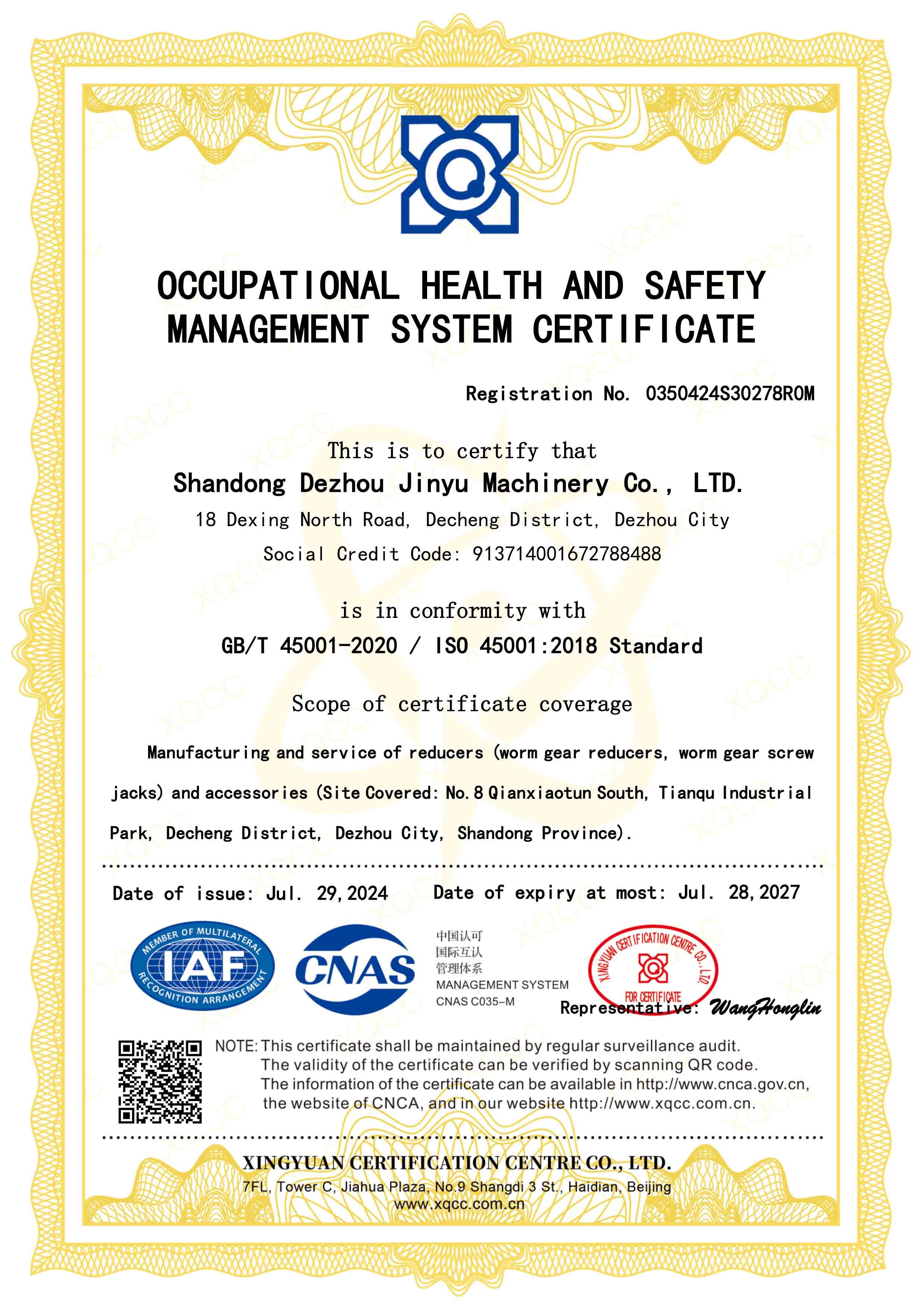
JINYU holds the following current certificates for its worm gear screw jack production:
- ISO 45001 — certificate number 0350424S30278ROM, issued by XQCC, standard GB/T 45001-2020 / ISO 45001:2018, valid from 2024-07-29 to 2027-07-28, covering the manufacture and service of reducers (worm gear reducers, worm gear screw jacks) and accessories.
- ISO 14001 — certificate number 0350424E20279ROM, issued by XQCC, standard GB/T 24001-2016 / ISO 14001:2015, valid from 2024-07-29 to 2027-07-28, covering the same scope.
- CE — certificate number GTSC20250516012-1-01, issued by GTS for the EU market, scope Ball Screw Actuators, referencing EN ISO 12100:2010 and EN 60204-1:2018, valid from 2025-06-13 to 2030-06-12.
Where motorised units are specified, IEC 62841-1:2014 covers general requirements for mechanical hazards in motor-operated tools and actuators (International Electrotechnical Commission), and is a useful reference point when reviewing motor and control documentation with the venue or the notified body.


Evidence from Multi-Point Lifting in Continuous Operation
The engineering demands of a synchronised stage platform — many points moving together, holding position, and running for years with minimal maintenance access — also appear in heavy industry. An installation of 80 JINYU JWM series worm gear screw jacks on a Danieli strip finishing line in Italy achieved stable multi-point synchronous lifting, high positioning accuracy and reliable self-locking, with long-term continuous operation in a harsh metallurgical environment. Key characteristics of that application include self-locking safety, low maintenance requirements, energy-saving operation, a compact structure and adaptation to the production line process. The system has demonstrated reliable performance over 8 years.
For a rigging engineer, the transferable point is not the industry but the duty pattern: dozens of points, one motion command, position held between movements, and a maintenance window that stays short for the life of the installation.
FAQ: Screw Jack Series Selection for Stage and Rigging Projects
1. What certifications should a stage screw jack supplier be able to document?
A supplier should be able to show certificates with verifiable numbers, scope and validity dates. JINYU holds ISO 45001 certificate 0350424S30278ROM (XQCC, valid 2024-07-29 to 2027-07-28), ISO 14001 certificate 0350424E20279ROM (XQCC, same validity period), and CE certificate GTSC20250516012-1-01 (GTS, valid 2025-06-13 to 2030-06-12) covering ball screw actuators against EN ISO 12100:2010 and EN 60204-1:2018. For motorised configurations, IEC 62841-1:2014 is the relevant general safety reference for motor-operated actuators.
2. Can the series be adapted to a specific stage load, stroke and speed?
Yes. JINYU works on an ODM basis and offers customised size, load, stroke, gear ratio, voltage, logo and material. Electric and manual screw jack configurations are both available, and a stainless steel screw jack configuration can be specified where corrosion resistance governs. For a stage project, the practical starting point is the load per lifting point, the required speed and the required stroke, which together point to the SWL, JWM or JWB band.
3. What drives the cost of a stage screw jack within these series?
The main cost drivers are the frame size needed for the load per point, the screw type (trapezoidal versus ball screw), the selected gear ratio, the stroke length, the protection class and the motor and control scope. Stainless steel construction and non-standard mounting or shaft configurations also affect the specification. Because the minimum order quantity is 1 unit, a single demonstration unit can be quoted and built before a multi-point system is released.
4. Can a sample unit be supplied for validation before the full order?
Yes. JINYU accepts orders from 1 unit, which allows a single jack to be tested against the actual load, speed and holding requirement before the full platform or rigging system is ordered. Every unit is 100% tested before shipment.
5. What is the typical lead time and production capacity?
Monthly production capacity is 10,000 units and typical lead time is 30–45 days. After-sales support is provided remotely, which suits the multi-point systems used in stage and rigging work. To move a stage or rigging project forward, the JINYU screw jack catalog can be downloaded here: JINYU screw jack product catalog (PDF).
Conclusion: Choose the Series from the Load, the Speed and the Holding Requirement
The series decision for stage lifting and rigging follows the physics of the application rather than a ranking of models. Where the load per point is heaviest and the travel is slow, the SWL series at 2.5–120 t and 0.1–0.6 m/min is the direct match, with up to 2000 mm of stroke and self-locking trapezoidal screw behaviour. Where the load band varies and positioning must be slow and repeatable, the JWM series covers 1–1000 kN at 0.2–1.8 m/min with gear ratios up to 32:1 and IP55–IP65 protection. Where the cue time is short, the JWB ball screw series reaches 0.5–5 m/min at 5–500 kN, with the holding function designed into the drive.
Whichever series is chosen, the multi-point system should be specified as a system: identical frame size and gear ratio across points, keyed or bevel gear layouts where the structure requires them, documented certificates, and a validated sample unit before the full order is released.
Manufacturer: SHANDONG JINYU MACHINERY CO., LTD (JINYU) — founded 1984, 20,000 m² factory, 258 employees, annual output 10,000 units, R&D team of 10, export share 30%, main markets EU / USA / Asia. Website: jyjack.com.
Contact: Josie — Josie@sdjymachinery.com, Tel / WhatsApp +8618963003132. Address: No.8, East of Yangguang Road, Tianqu Industrial Park, Decheng District, Dezhou City, Shandong Province, China.

Next step: send the load per lifting point, required speed and stroke for your stage or rigging project, and JINYU will confirm which series applies and quote a sample unit. Download the screw jack catalog or contact Josie at Josie@sdjymachinery.com.
Have Questions or Need More Details?
Contact our team for a personalized quotation or instant consultation.
Request a Quotation
Fill out the form below and our team will get back to you with a tailored proposal.
WhatsApp Direct Chat
Prefer to chat in real-time? Message us on WhatsApp for instant assistance & quick answers.
- Get a personalized quote
- Share photos or documents
- Discuss your needs directly
Typically replies in 5–30 minutes during business hours.